
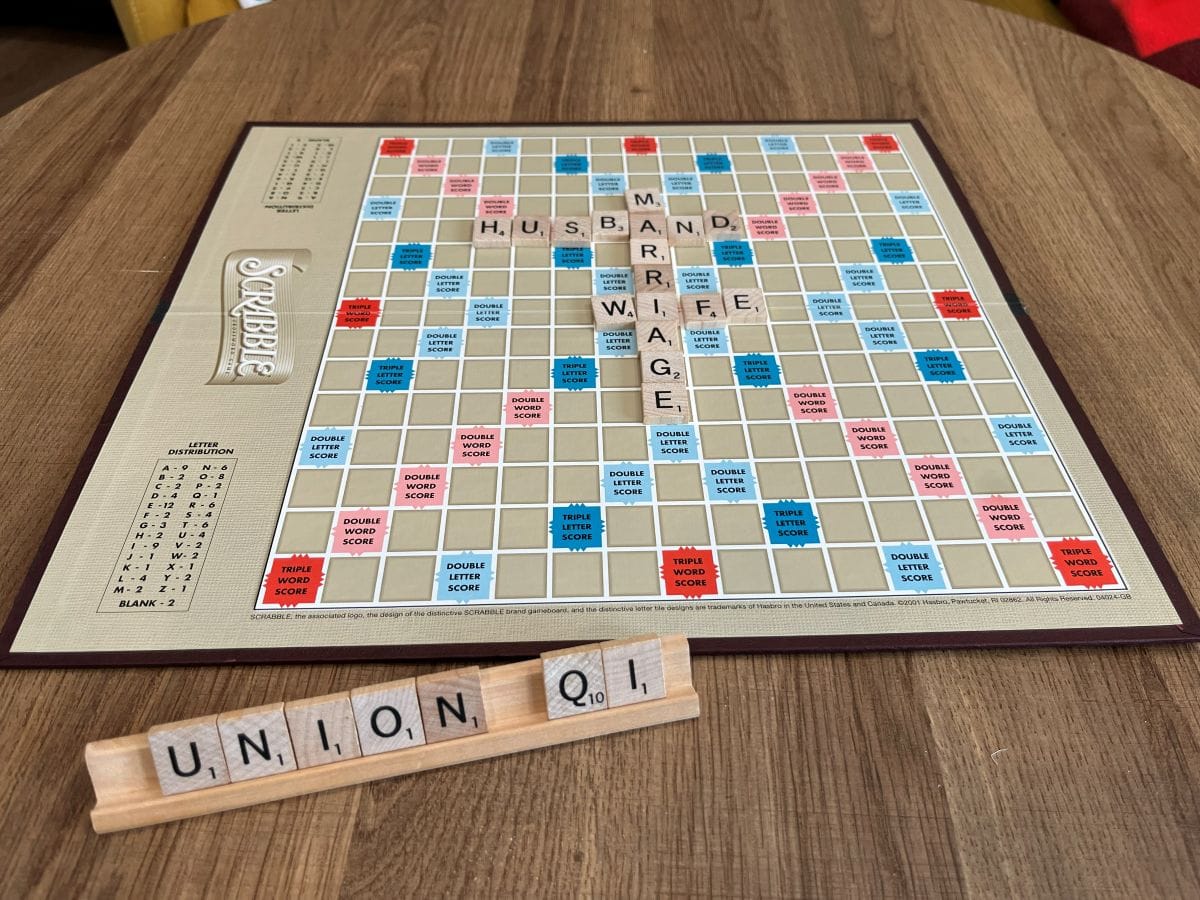
Marriage Lessons from Scrabble: Play the Tiles You Have
“Come on, one more game!” I said.
Over the last year or so, my children have surprised me with an interest in playing Scrabble. This is pure delight for me, as it is one of my favorite games.
My daughter replied, “Ok, but only if you are not allowed to play the word qi. What does that even mean, anyway?” (did I mention how aggravated they get that I’m quite good?)
Accepting this handicap, I went on to lose the game. Not because I couldn’t play qi (and not because I only had one-point letters the entire time), but because my kids are getting better. Watching them improve reminded me that Scrabble—like marriage—is less about the tiles you start with and more about how you learn to play over time.
As Valentine’s Day approaches, I have found myself thinking a lot about my marriage and how much it reminds me of playing Scrabble.
What Scrabble Teaches Us About Marriage
Before we begin, we each pick out our seven letters from the bag. As we place them on our letter rack, we can consent to the letters or swap them out on our next turn. But in any case, eventually we have to play the best we can with the tiles we choose.
Once the game begins, we must form the best words we can, with the goal of earning the most points. There are many different strategies. We can form an amazingly clever word, only to place it on the board and discover it’s worth only seven points. Or sometimes, simply using a single letter can earn us fifty points. Learning how to play the tiles in front of you in the best possible way is the goal.
My favorite strategy is looking for ways to make multiple words and always using a double or triple word score. I get excited when my kids come up with cool words earning great points—even if they take my spot. The words played are always dependent on the decisions of others in the game. I am not allowed to play a word in a different part of the board; my word must play off of another’s.
Like marriage.
Choosing Our Tiles: The Early Decisions of Marriage
We meet people, date, fall in love, and decide to marry. These are all things we choose. Getting married—oftentimes when we are quite young—can feel like picking tiles from a bag. When I picked my “tiles,” I knew I wanted to marry someone who shared my Catholic faith, did not drink or smoke, was healthy, ambitious, able to support a family, and who came from an intact family. Those tiles were my starting points.
We had no idea when we began what the trajectory of our life would be, similar to Scrabble. This is true in every marriage. Would there be illness, poverty, job loss, infertility? We are all faced with the unknown.
Marriage Is Never Played Alone
With each turn, we continue to play our tiles based on each other’s choices. And so it goes. In order to keep going, my next move cannot be on a different part of the board, but rather must involve or incorporate his in some way. And together, the board grows.

The Sacrament of Marriage and God’s Grace
Our ever-evolving relationship with God can sometimes cause us to question the choices we made in the past. “If only I had not done this, or done that,” or “If only I had known then what I know now.” But with God—and the grace He gives us in the Sacrament of Marriage—we can grow better at knowing which moves will bring the most points.
God seals our marriage in Heaven. This vocation becomes our path to Heaven—the good, the bad, and the ugly. We see the best in ourselves and the worst. We are formed and we experiment with new ways of being, all in union with one another. When we grow in holiness at different speeds, or marry without the sacrament, we can begin to wonder if we chose incorrectly. But if we go back to that original bag of tiles—did we know how holy we would become?
Faithful Commitment Over Perfect Choices
Wondering about past choices can get in the way of enjoying the life we have. No one ever gets halfway through a Scrabble game and blames their original tiles for where they are in the game. Sometimes the words come easily or maybe we have two or three options. Other times we just have to get through with that two-point word.
But it is not done alone.
The point of the game is to play, to have fun, and to be together.
Even if your opponent plays qi for sixty-three points.





Margaret – thank you for this reminder that marriage is both a commitment between spouses and a commitment with God. That no matter what choices we made in the early, heady days of romantic love, we only win the game by remaining united with the Master Strategist, whose graces allow us to walk together the narrow path of life and marriage.
On a side note, in Chinese philosophy, Qi refers to the vital life force. As Catholics, the only vital life force we need be concerned with is union with the Father, Son, and Holy Spirit.
Yes indeed! Just keep playing!